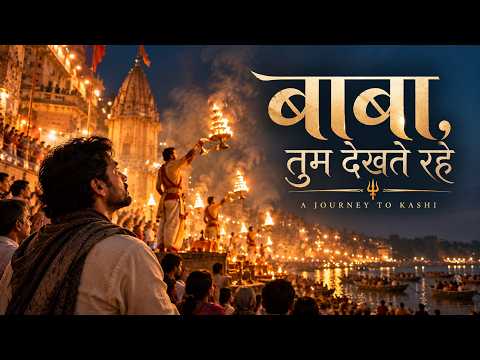
"Baba, Tum Dekhte Rahe" is a cinematic Hindi devotional song set in Kashi that tells the story of a seeker who travels to find Shiva — only to realize that Shiva was watching over him all along.
There is a particular kind of humbling that happens in Kashi. You arrive with your questions, your rituals, your intentions. And somewhere between the ancient lanes and the fire of the Ganga Aarti, something quietly shifts. This song captures that shift. It does not announce itself with grand proclamations. It simply walks beside you through the ghats and lets the realization come on its own.
What Does "Baba, Tum Dekhte Rahe" Actually Mean?
"Baba, Tum Dekhte Rahe" translates directly as "Baba, You kept watching" — and in that simple phrase lives the entire philosophy of surrender to Shiva. In the devotional traditions of Shaivism, Baba Vishwanath is not a distant deity to be reached through effort alone. He is the witness consciousness, ever present, ever aware, watching the soul long before the soul turns to look for him. The song's central line — "I came searching for you, but you were already reading me" — reflects this idea with quiet power. Shiva in Kashi is not a destination. He is the one who already knows your address.
Vishwanath, meaning "Lord of the Universe," is one of the twelve Jyotirlingas and is considered among the holiest manifestations of Shiva. Kashi, known today as Varanasi or Banaras, is believed to be Shiva's own city — a place where even death is said to be a doorway to liberation. To visit is to stand at the intersection of the human and the eternal.
The Inner Journey This Song Describes
This song is fundamentally about the gap between searching outward and discovering inward — a journey every sincere seeker eventually makes. The imagery moves through Dashashwamedh Ghat, the Ganga, the narrow lanes of the old city, and the threshold of the Vishwanath temple. But these are not just geographic markers. Each is a stage of inner arrival. The Ganga flowing endlessly represents the continuity of divine grace. The aarti flame at dusk represents the moment the seeker stops grasping and simply receives. By the time the song ends, the listener understands: the ghats did not change. The person did.
The style — cinematic devotional blended with Banaras Hindustani and semi-classical folk — is deliberate. It keeps one foot in the sacred and one in the human. It does not require you to be a scholar of scripture. It only requires you to listen.
When and How to Use This Track
This song works best as a meditative companion during quiet, intentional moments rather than as background music — listening with headphones, as recommended, makes a noticeable difference. It is well-suited for morning meditation before or after personal puja, for the period of stillness following the chanting of Om Namah Shivaya, or during Pradosh Vrat and Mahashivratri observances when reflection on Shiva's nature carries extra meaning. It can also anchor a longer evening sit, especially if you are working with the idea of surrender — letting go of the sense that spiritual progress is something you manufacture entirely through your own will.
For those who have visited Kashi or who hold a devotion to Baba Vishwanath, this song will feel like returning somewhere familiar. For those who have never been, it may plant the wish to go. Either way, the real journey it points to is the one that happens without leaving your seat.
Common questions
What does "Baba Tum Dekhte Rahe" mean in English?
It means "Baba, You kept watching" — expressing the devotee's realization that Shiva was already aware of and present with them before they even began their search.
Who is Baba Vishwanath and why is Kashi important to Shiva devotees?
Baba Vishwanath is one of the twelve Jyotirlingas, a sacred form of Shiva enshrined in Varanasi, and Kashi is considered Shiva's own city where liberation is said to be granted to all who die there.
When is the best time to listen to this devotional song?
It is best suited for morning or evening meditation, during Pradosh Vrat or Mahashivratri, or any quiet moment of personal reflection and surrender — ideally with headphones for the full experience.
Enjoyed this? Follow Soulful Music India for more.